The K-Shaped Future of Software Engineering
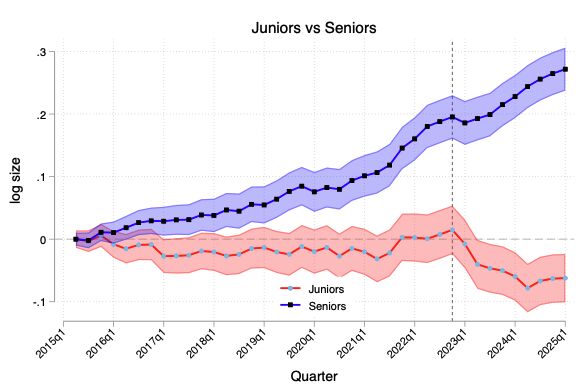
Source: Harvard University
Developers are cooked.
If machines can code this well now, what's even the point of engineering?
The obvious answer sounds smart on the surface: it's over for developers. Like an agricultural society meeting the tractor, software engineers will need to reskill and do something else.
You'll often hear this take from people drawing parallels to the industrial revolution, or from founders raising their next huge AI round.
What's actually happening is the tech industry is splitting in two. We're at the beginning of a K-shaped divergence: some engineers becoming more valuable than ever, while others watch their skills depreciate in real-time.
Engineering is being displaced not replaced
AI isn't replacing software development, it's displacing it. The tech industry is reshaping what work looks like and who captures the value.
After over a decade working with engineering teams, I've noticed consistent themes of what separates high teams from mediocre ones. It rarely just has to do with coding speed.
Consider two teams:
Team A:
- Cares about impact, not activity
- Handles ambiguous problems without paralysis
- Understands the product, business, and data not just the codebase
- Designs high-leverage systems and actively reduces complexity
- Adopts new tools quickly and applies them with taste
- Stays comfortable during long stretches of exploration before committing to a direction
- Finds creative solutions to hard problems
- Obsesses over the user experience
Team B:
- Debates libraries and design patterns as a form of procrastination
- Builds before understanding the problem
- Fixates on performative code quality
- Bikesheds details instead of making users happy
- Complains about headcount and stretches timelines
- Adds process when things feel chaotic
Which team benefits more from AI that can generate working code in seconds?
The answer is obvious once you see it: AI is leverage, and leverage amplifies whatever you already are. Team A uses that leverage to explore more solutions, ship faster, and tackle problems they previously couldn't prioritize. Team B uses it to generate more code that wasn't going to be impactful anyway.
When I was at Pinterest, we were tasked with growing the SMB advertising business by 5x without a clear roadmap. My team rallied around this goal, shipping dozens of experiments. We redesigned onboarding, deployed ML models to improve targeting, dove into unfamiliar codebases and collaborated across product, data science, and sales continuously. Some bets worked and some didn't but we ended up overshooting our goal during my tenure there.
Was coding the most important part? It sure didn't feel like it. The code felt like an annoying means to an end. In the age of AI, that friction collapses tenfold.
Demand Won't Collapse
Software is unusual. Unlike farming or manufacturing, there's no natural ceiling on demand. There's no field that's fully planted, no quota that's been met. The work expands to fill the available capacity and then expands further.
When engineers become 3x more productive, companies don't automatically cut headcount by two-thirds. They chase opportunities they previously couldn't afford to pursue. They enter adjacent markets. They rebuild systems that were too expensive to touch. They raise the bar for what "good enough" means.
This isn't new. Technology companies have poured tens of billions of dollars into engineering productivity for decades. If coding output was the primary edge in the competitive marketplace, Google or Microsoft's army of engineers would've eaten up all of software a long time ago.
The difference this time in 2026 is speed. Previous platform shifts played out over years and this one is measured in months. The teams that adapt quickly will compound their advantages. The ones that don't will find themselves increasingly outgunned. The technology industry doesn't exist in a vacuum of Jira ticket punching, it's become one of the most competitive industries in the world.
The Part That's Actually Hard
Here's what I think people miss: coding was never the hardest part.
The hard part is figuring out what to build and understanding users well enough to know what they actually need. It's selling an idea to skeptical stakeholders. It's making good decisions with incomplete information. It's maintaining momentum through the long middle of a project when the initial excitement has faded and the finish line isn't yet visible.
Staff+ engineers aren't paid more in the company because they code faster or have a bag of programming tricks. They're paid for judgment, for context, for the ability to see around corners. They are paid to ship, to own mistakes, to parallelize workstreams and remove risk.
They have scar tissue from failures in the past and, unlike Opus 4.5, they'll push back when something you're asking is dumb. None of that is going away. If anything, it's becoming more important as teams strap themselves to coding agents that can help them build more of the wrong thing but much faster.
The Question Worth Asking
Here's a diagnostic: When's the last time you shipped something that moved a metric your company actually cares about? When's the last time you talked to a user? When's the last time you worked on something genuinely ambiguous? When was the last time you jammed on a project with sales, marketing, or customer service?
If you can't answer quickly, you know which team you might be on.
The good news is that everyone is figuring out this bold new future together. The playbooks haven't been written yet and in many ways we're still at the very beginning of the AI wave. Companies are starving for people that can help them figure it out.
Like the technology revolutions before it, AI will be a period to reinvent ourselves, our work and our search for meaning in the universe. The ones that cross the chasm to the other side will find themselves happier and more valuable than ever.
The ones who wait for the dust to settle may find there's no ground left to stand on.